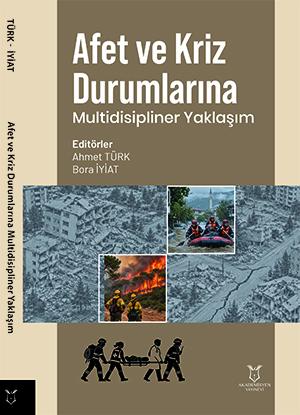
Afet ve Kriz Durumlarında Multıdisipliner Yaklaşım: Kavramsal Çerçeve, Kuramsal Temeller ve Disiplinlerarası İş Birliği
Synopsis
Disasters and crises are multidimensional phenomena that extend beyond events affecting the physical environment and economic structures, simultaneously transforming social relationships, institutional functioning, and individual living conditions. This necessitates an approach to disaster management that goes beyond the knowledge and intervention capacities of a single discipline. Reducing disaster risks, ensuring effective emergency response, and promoting sustainable societal recovery require collaboration among various fields, including health sciences, engineering, social sciences, management sciences, communication, and information technologies, within a common framework. This chapter aims to explain the conceptual scope of the multidisciplinary approach to disaster and crisis management, examine its theoretical foundations, and identify the key conditions for interdisciplinary collaboration. In this context, systems theory, the ecological approach, complexity theory, and the concept of community resilience are discussed collectively. Furthermore, the institutional, epistemological, and ethical dimensions of interdisciplinary coordination are evaluated to explore the fundamental principles of integrated disaster management. Ultimately, the chapter argues that effective disaster management can be achieved not merely by bringing different areas of expertise together, but by integrating diverse forms of knowledge through shared objectives, collective responsibilities, and coordinated decision-making processes.
References
Adger, W. N. (2006). Vulnerability. Global Environmental Change, 16(3), 268–281. https://doi.org/10.1016/j.gloenvcha.2006.02.006
Afet ve Acil Durum Yönetimi Başkanlığı [AFAD]. (2022). Türkiye Afet Risk Azaltma Planı (TARAP) 2022–2030. 17 Eylül 2026 tarihinde https://afad.gov.tr/turkiye-afet-risk-azaltma-plani-tarap adresinden erişildi.
Alexander, D. (2005). Towards the development of a standard in emergency planning. Disaster Prevention and Management, 14(2), 158–175. https://doi.org/10.1108/09653560510595164
Angın, C. (2024). Afet yönetiminde mülki idare ve belediyeler: İş birliğine dayalı afet yönetimi yaklaşımıyla 6 Şubat 2023 depremleri. Memleket Siyaset Yönetim, 19(43), 687–714. https://doi.org/10.56524/msydergi.1512154
Ansell, C., & Gash, A. (2008). Collaborative governance in theory and practice. Journal of Public Administration Research and Theory, 18(4), 543–571. https://doi.org/10.1093/jopart/mum032
Bankoff, G., Frerks, G., & Hilhorst, D. (Ed.). (2004). Mapping vulnerability: Disasters, development and people. Earthscan.
Bharosa, N., Lee, J., & Janssen, M. (2010). Challenges and obstacles in sharing and coordinating information during multi-agency disaster response. Information Systems Frontiers, 12(1), 49–65. https://doi.org/10.1007/s10796-009-9174-z
Boin, A., 't Hart, P., Stern, E., & Sundelius, B. (2016). The politics of crisis management: Public leadership under pressure. Cambridge University Press.
Bronfenbrenner, U. (1979). The ecology of human development: Experiments by nature and design. Harvard University Press.
Choi, B. C., & Pak, A. W. (2006). Multidisciplinarity, interdisciplinarity and transdisciplinarity in health research, services, education and policy: 1. Definitions, objectives, and evidence of effectiveness. Clinical and Investigative Medicine, 29(6), 351–364.
Comfort, L. K. (1999). Shared risk: Complex systems in seismic response. Pergamon.
Comfort, L. K. (2007). Crisis management in hindsight: Cognition, communication, coordination, and control. Public Administration Review, 67(1), 189–197. https://doi.org/10.1111/j.1540-6210.2007.00793.x
Cutter, S. L., Barnes, L., Berry, M., Burton, C., Evans, E., Tate, E., & Webb, J. (2008). A place-based model for understanding community resilience to natural disasters. Global Environmental Change, 18(4), 598–606. https://doi.org/10.1016/j.gloenvcha.2008.07.013
Cutter, S. L., Boruff, B. J., & Shirley, W. L. (2003). Social vulnerability to environmental hazards. Social Science Quarterly, 84(2), 242–261. https://doi.org/10.1111/1540-6237.8402002
Gall, M., Nguyen, K. H., & Cutter, S. L. (2015). Integrated research on disaster risk: Is it really integrated?. International Journal of Disaster Risk Reduction, 12, 255–267. https://doi.org/10.1016/j.ijdrr.2015.01.010
Holling, C. S. (1973). Resilience and stability of ecological systems. Annual Review of Ecology and Systematics, 4(1), 1–23. https://doi.org/10.1146/annurev.es.04.110173.000245
Kapucu, N. (2008). Collaborative emergency management: Better community organising, better public preparedness and response. Disasters, 32(2), 239–262. https://doi.org/10.1111/j.1467-7717.2008.01037.x
Kapucu, N., & Garayev, V. (2011). Collaborative decision-making in emergency and disaster management. International Journal of Public Administration, 34(6), 366–375. https://doi.org/10.1080/01900692.2011.561477
Kendra, J. M., & Wachtendorf, T. (2003). Elements of resilience after the world trade center disaster: Reconstituting New York City's emergency operations centre. Disasters, 27(1), 37–53. https://doi.org/10.1111/1467-7717.00218
Lang, D. J., Wiek, A., Bergmann, M., Stauffacher, M., Martens, P., Moll, P., ... & Thomas, C. J. (2012). Transdisciplinary research in sustainability science: practice, principles, and challenges. Sustainability Science, 7(1), 25-43. https://doi.org/10.1007/s11625-011-0149-x
Manyena, S. B. (2006). The concept of resilience revisited. Disasters, 30(4), 434–450. https://doi.org/10.1111/j.0361-3666.2006.00331.x
Mercer, J., Kelman, I., Taranis, L., & Suchet-Pearson, S. (2010) Framework for Integrating Indigenous and Scientific Knowledge for Disaster Risk Reduction. Disasters, 34, 214-239. https://doi.org/10.1111/j.1467-7717.2009.01126.x
Mileti, D. S. (1999). Disasters by design: A reassessment of natural hazards in the United States. Joseph Henry Press.
Moynihan, D. P. (2009). The network governance of crisis response: Case studies of incident command systems. Journal of Public Administration Research and Theory, 19(4), 895–915. https://doi.org/10.1093/jopart/mun033
Norris, F. H., Stevens, S. P., Pfefferbaum, B., Wyche, K. F., & Pfefferbaum, R. L. (2008). Community resilience as a metaphor, theory, set of capacities, and strategy for disaster readiness. American Journal of Community Psychology, 41(1–2), 127–150. https://doi.org/10.1007/s10464-007-9156-6
Oliver-Smith, A. (1996). Anthropological research on hazards and disasters. Annual Review of Anthropology, 25, 303–328. https://doi.org/10.1146/annurev.anthro.25.1.303
Pearce, L. (2003). Disaster management and community planning, and public participation: How to achieve sustainable hazard mitigation. Natural Hazards, 28(2), 211–228. https://doi.org/10.1023/A:1022917721797
Pelling, M. (2011). Adaptation to climate change: From resilience to transformation. Routledge.
Perry, R. W. (2007). What is a disaster?. In H. Rodríguez, E. L. Quarantelli, & R. R. Dynes (Eds.), Handbook of disaster research (pp. 1–15). Springer. https://doi.org/10.1007/978-0-387-32353-4_1
Pescaroli, G., & Alexander, D. (2015). A definition of cascading disasters and cascading effects: Going beyond the “toppling dominos” metaphor. Planet@ risk, 3(1), 58-67.
Repko, A. F., & Szostak, R. (2020). Interdisciplinary research: Process and theory. SAGE Publications.
Sandoval, V., Voss, M., Flörchinger, V., Lorenz, S., & Jafari, P. (2023). Integrated disaster risk management (IDRM): Elements to advance its study and assessment. International Journal of Disaster Risk Science, 14, 343–356. https://doi.org/10.1007/s13753-023-00490-1
Sarı, B., & Özer, Y. E. (2024). Coordination analysis in disaster management: A qualitative approach in Türkiye. International Journal of Disaster Risk Reduction, 100, 104168. https://doi.org/10.1016/j.ijdrr.2023.104168
Tierney, K. J. (2014). The social roots of risk: Producing disasters, promoting resilience. Stanford University Press.
Türk, A. (2022). Deprem özelinde engelli bireylere duyarlı afet yönetimi modeli. Afet ve Risk Dergisi, 5(1), 61-77. https://doi.org/10.35341/afet.1078869
Türk, A., & Bilican-Gökkaya, V. (2023). Deprem sonrası çocukların karşılaşabileceği psikososyal riskler ve sosyal hizmet. İ. Aydemir & M. Öztürk (Ed.), Afet ve Krizlerde Sosyal Hizmet (ss. 163-187) içinde. Akademisyen Kitabevi.
United Nations Office for Disaster Risk Reduction [UNDRR]. (2015). Sendai framework for disaster risk reduction 2015-2030. 22 Eylül 2026 tarihinde https://www.undrr.org/publication/sendai-framework-disaster-risk-reduction-2015-2030 adresinden erişildi.
United Nations Office for Disaster Risk Reduction [UNDRR]. (2017). Terminology on disaster risk reduction. 22 Eylül 2026 tarihinde https://www.undrr.org/terminology adresinden erişildi.
von Bertalanffy, L. (1968). General system theory: Foundations, development, applications. George Braziller.
Waugh, W. L., & Streib, G. (2006). Collaboration and leadership for effective emergency management. Public Administration Review, 66(1), 131–140. https://doi.org/10.1111/j.1540-6210.2006.00673.x
Weichselgartner, J., & Pigeon, P. (2015). The role of knowledge in disaster risk reduction. International Journal of Disaster Risk Science, 6(2), 107–116. https://doi.org/10.1007/s13753-015-0052-7
Wisner, B., Blaikie, P., Cannon, T., & Davis, I. (2004). At risk: Natural hazards, people's vulnerability and disasters. Routledge.
World Health Organization [WHO]. (2019). Health emergency and disaster risk management framework. 20 Eylül 2026 tarihinde https://www.who.int/publications-detail-redirect/9789241516181 adresinden erişildi.