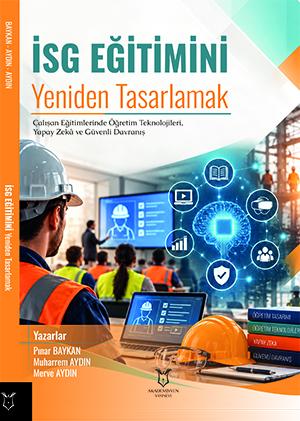
İSG Eğitimini Yeniden Tasarlamak: Çalışan Eğitimlerinde Öğretim Teknolojileri, Yapay Zekâ ve Güvenli Davranış
Özet
-
Referanslar
Alliger, G. M., Tannenbaum, S. I., Bennett, W., Jr., Traver, H., & Shotland, A. (1997). A meta-analysis of the relations among training criteria. Personnel Psychology, 50(2), 341–358. https://doi.org/10.1111/j.1744-6570.1997.tb00911.x
Anderson, L. W. (2002). Curricular alignment: A re-examination. Theory Into Practice, 41(4), 255–260. https://doi.org/10.1207/s15430421tip4104_9
Arthur, W., Jr., Bennett, W., Jr., Edens, P. S., & Bell, S. T. (2003). Effectiveness of training in organizations: A meta-analysis of design and evaluation features. Journal of Applied Psychology, 88(2), 234–245. https://doi.org/10.1037/0021-9010.88.2.234
Baldwin, T. T., & Ford, J. K. (1988). Transfer of training: A review and directions for future research. Personnel Psychology, 41(1), 63–105. https://doi.org/10.1111/j.1744-6570.1988.tb00632.x
Bastani, H., Bastani, O., Sungu, A., Ge, H., Kabakcı, Ö., & Mariman, R. (2025). Generative AI without guardrails can harm learning: Evidence from high school mathematics. Proceedings of the National Academy of Sciences, 122(26), Makale e2422633122. https://doi.org/10.1073/pnas.2422633122
Bates, R. (2004). A critical analysis of evaluation practice: The Kirkpatrick model and the principle of beneficence. Evaluation and Program Planning, 27(3), 341–347. https://doi.org/10.1016/j.evalprogplan.2004.04.011
Biggs, J. (1996). Enhancing teaching through constructive alignment. Higher Education, 32(3), 347–364. https://doi.org/10.1007/BF00138871
Bloom, B. S. (1984). The 2 sigma problem: The search for methods of group instruction as effective as one-to-one tutoring. Educational Researcher, 13(6), 4–16. https://doi.org/10.3102/0013189X013006004
Blume, B. D., Ford, J. K., Baldwin, T. T., & Huang, J. L. (2010). Transfer of training: A meta-analytic review. Journal of Management, 36(4), 1065–1105. https://doi.org/10.1177/0149206309352880
Branch, R. M. (2009). Instructional design: The ADDIE approach. Springer. https://doi.org/10.1007/978-0-387-09506-6
Burke, L. A., & Hutchins, H. M. (2007). Training transfer: An integrative literature review. Human Resource Development Review, 6(3), 263–296. https://doi.org/10.1177/1534484307303035
Burke, M. J., Salvador, R. O., Smith-Crowe, K., Chan-Serafin, S., Smith, A., & Sonesh, S. (2011). The dread factor: How hazards and safety training influence learning and performance. Journal of Applied Psychology, 96(1), 46–70. https://doi.org/10.1037/a0021838
Burke, M. J., Sarpy, S. A., Smith-Crowe, K., Chan-Serafin, S., Salvador, R. O., & Islam, G. (2006). Relative effectiveness of worker safety and health training methods. American Journal of Public Health, 96(2), 315–324. https://doi.org/10.2105/AJPH.2004.059840
Cepeda, N. J., Pashler, H., Vul, E., Wixted, J. T., & Rohrer, D. (2006). Distributed practice in verbal recall tasks: A review and quantitative synthesis. Psychological Bulletin, 132(3), 354–380. https://doi.org/10.1037/0033-2909.132.3.354
Çalışanların İş Sağlığı ve Güvenliği Eğitimlerinin Usul ve Esasları Hakkında Yönetmelik [Mülga]. (2013, 15 Mayıs). Resmî Gazete (Sayı: 28648).
Çalışanların İş Sağlığı ve Güvenliği Eğitimlerinin Usul ve Esasları Hakkında Yönetmelik. (2026, 2 Nisan). Resmî Gazete (Sayı: 33212).
Çobanlar, G. A., Uçar, D., Sakarlı, İ. A., & Ülker, O. (2026). İş sağlığı ve güvenliğinde VR kullanımına ilişkin senaryo temelli bir değerlendirme: Mobilya dersi kapsamında yenilikçi bir yaklaşım. Mobilya ve Ahşap Malzeme Araştırmaları Dergisi, 9(1), 47–62. https://doi.org/10.33725/mamad.1863869
Dell’Acqua, F., McFowland, E., III, Mollick, E., Lifshitz, H., Kellogg, K. C., Rajendran, S., Krayer, L., Candelon, F., & Lakhani, K. R. (2026). Navigating the jagged technological frontier: Field experimental evidence of the effects of artificial intelligence on knowledge worker productivity and quality. Organization Science, 37(2), 403–423. https://doi.org/10.1287/orsc.2025.21838
Elle Taşıma İşleri Yönetmeliği. (2013, 24 Temmuz). Resmî Gazete (Sayı: 28717).
Erten, B., Oral, B., & Yakut, M. Z. (2022). The role of virtual and augmented reality in occupational health and safety training of employees in PV power systems and evaluation with a sustainability perspective. Journal of Cleaner Production, 379, Makale 134499. https://doi.org/10.1016/j.jclepro.2022.134499
Federal Aviation Administration. (2013). Manual flight operations (Safety Alert for Operators No. 13002). U.S. Department of Transportation. http://www.faa.gov/other_visit/aviation_industry/airline_operators/airline_safety/safo
Health and Safety Executive. (t.y.). Managing human failures: Overview. 11 Ekim 2026 tarihinde https://hse.gov.uk/humanfactors/topics/humanfail.htm adresinden erişildi.
Health and Safety Executive. (1999). Reducing error and influencing behaviour (2. bs., HSG48). The Stationery Office. https://www.hse.gov.uk/pubns/books/hsg48.htm
International Labour Organization. (2023). Safe and healthy working environments for all: Realizing the fundamental right to a safe and healthy working environment worldwide (ILO Introductory Report, 23rd World Congress on Safety and Health at Work). https://webapps.ilo.org/wcmsp5/groups/public/---ed_protect/---protrav/---safework/documents/publication/wcms_906187.pdf
İş Ekipmanlarının Kullanımında Sağlık ve Güvenlik Şartları Yönetmeliği. (2013, 25 Nisan). Resmî Gazete (Sayı: 28628).
İş Ekipmanlarının Kullanımında Sağlık ve Güvenlik Şartları Yönetmeliğinde Değişiklik Yapılmasına Dair Yönetmelik. (2022, 18 Şubat). Resmî Gazete (Sayı: 31754).
İş Sağlığı ve Güvenliği Kanunu (Kanun No. 6331). (2012, 30 Haziran). Resmî Gazete (Sayı: 28339).
Kasneci, E., Sessler, K., Küchemann, S., Bannert, M., Dementieva, D., Fischer, F., Gasser, U., Groh, G., Günnemann, S., Hüllermeier, E., Krusche, S., Kutyniok, G., Michaeli, T., Nerdel, C., Pfeffer, J., Poquet, O., Sailer, M., Schmidt, A., Seidel, T., . . . Kasneci, G. (2023). ChatGPT for good? On opportunities and challenges of large language models for education. Learning and Individual Differences, 103, Makale 102274. https://doi.org/10.1016/j.lindif.2023.102274
Kestin, G., Miller, K., Klales, A., Milbourne, T., & Ponti, G. (2025). AI tutoring outperforms in-class active learning: An RCT introducing a novel research-based design in an authentic educational setting. Scientific Reports, 15, Makale 17458. https://doi.org/10.1038/s41598-025-97652-6
Kimyasal Maddelerle Çalışmalarda Sağlık ve Güvenlik Önlemleri Hakkında Yönetmelik. (2013, 12 Ağustos). Resmî Gazete (Sayı: 28733).
Kimyasal Maddelerle Çalışmalarda Sağlık ve Güvenlik Önlemleri Hakkında Yönetmelikte Değişiklik Yapılmasına Dair Yönetmelik. (2023, 20 Ekim). Resmî Gazete (Sayı: 32345).
Kişisel Verilerin Korunması Kanunu (Kanun No. 6698). (2016, 7 Nisan). Resmî Gazete (Sayı: 29677).
Klein, G. (2008). Naturalistic decision making. Human Factors, 50(3), 456–460. https://doi.org/10.1518/001872008X288385
Kraiger, K., Ford, J. K., & Salas, E. (1993). Application of cognitive, skill-based, and affective theories of learning outcomes to new methods of training evaluation. Journal of Applied Psychology, 78(2), 311–328. https://doi.org/10.1037/0021-9010.78.2.311
Krathwohl, D. R. (2002). A revision of Bloom’s taxonomy: An overview. Theory Into Practice, 41(4), 212–218. https://doi.org/10.1207/s15430421tip4104_2
Kulik, J. A., & Fletcher, J. D. (2016). Effectiveness of intelligent tutoring systems: A meta-analytic review. Review of Educational Research, 86(1), 42–78. https://doi.org/10.3102/0034654315581420
Martimo, K.-P., Verbeek, J., Karppinen, J., Furlan, A. D., Takala, E.-P., Kuijer, P. P. F. M., Jauhiainen, M., & Viikari-Juntura, E. (2008). Effect of training and lifting equipment for preventing back pain in lifting and handling: Systematic review. BMJ, 336(7641), 429–431. https://doi.org/10.1136/bmj.39463.418380.BE
Merrill, M. D. (2002). First principles of instruction. Educational Technology Research and Development, 50(3), 43–59. https://doi.org/10.1007/BF02505024
Merrill, M. D. (2007). First principles of instruction: A synthesis. R. A. Reiser & J. V. Dempsey (Ed.), Trends and issues in instructional design and technology (2. bs., s. 62–71) içinde. Merrill/Prentice Hall.
Miao, F., & Holmes, W. (2023). Guidance for generative AI in education and research. UNESCO. https://doi.org/10.54675/EWZM9535
Molenda, M. (2015). In search of the elusive ADDIE model. Performance Improvement, 54(2), 40–42. https://doi.org/10.1002/pfi.21461 (Özgün çalışma 2003’te yayımlanmıştır)
Mollick, E., & Mollick, L. (2023). Using AI to implement effective teaching strategies in classrooms: Five strategies, including prompts. SSRN. https://ssrn.com/abstract=4391243
Neal, A., & Griffin, M. A. (2006). A study of the lagged relationships among safety climate, safety motivation, safety behavior, and accidents at the individual and group levels. Journal of Applied Psychology, 91(4), 946–953. https://doi.org/10.1037/0021-9010.91.4.946
Occupational Safety and Health Administration. (2019). Using leading indicators to improve safety and health outcomes (OSHA 3970). U.S. Department of Labor. https://www.osha.gov/leadingindicators
Oviedo-Trespalacios, O., Peden, A. E., Cole-Hunter, T., Costantini, A., Haghani, M., Rod, J. E., Kelly, S., Torkamaan, H., Tariq, A., Newton, J. D. A., Gallagher, T., Steinert, S., Filtness, A. J., & Reniers, G. (2023). The risks of using ChatGPT to obtain common safety-related information and advice. Safety Science, 167, Makale 106244. https://doi.org/10.1016/j.ssci.2023.106244
Phimister, J. R., Oktem, U., Kleindorfer, P. R., & Kunreuther, H. (2003). Near-miss incident management in the chemical process industry. Risk Analysis, 23(3), 445–459. https://doi.org/10.1111/1539-6924.00326
Regulation (EU) 2016/679 of the European Parliament and of the Council of 27 April 2016 on the protection of natural persons with regard to the processing of personal data and on the free movement of such data, and repealing Directive 95/46/EC (General Data Protection Regulation). (2016, 4 Mayıs). Official Journal of the European Union, L 119, 1–88. http://data.europa.eu/eli/reg/2016/679/oj
Regulation (EU) 2024/1689 of the European Parliament and of the Council of 13 June 2024 laying down harmonised rules on artificial intelligence and amending Regulations (EC) No 300/2008, (EU) No 167/2013, (EU) No 168/2013, (EU) 2018/858, (EU) 2018/1139 and (EU) 2019/2144 and Directives 2014/90/EU, (EU) 2016/797 and (EU) 2020/1828 (Artificial Intelligence Act). (2024, 12 Temmuz). Official Journal of the European Union, L, 2024/1689. http://data.europa.eu/eli/reg/2024/1689/oj
Regulation (EU) 2026/1744 of the European Parliament and of the Council of 8 July 2026 amending Regulations (EU) 2024/1689, (EU) 2018/1139 and (EU) 2023/1230 as regards the simplification of the implementation of harmonised rules on artificial intelligence (Digital Omnibus on AI). (2026, 24 Temmuz). Official Journal of the European Union, L, 2026/1744. http://data.europa.eu/eli/reg/2026/1744/oj
Reinhold, K., Järvis, M., Christenko, A., Jankauskaitė, V., Paliokaitė, A., & Riedmann, A. (2022). Artificial intelligence for worker management: Implications for occupational safety and health. European Agency for Safety and Health at Work. https://doi.org/10.2802/76354
Ricci, F., Chiesi, A., Bisio, C., Panari, C., & Pelosi, A. (2016). Effectiveness of occupational health and safety training: A systematic review with meta-analysis. Journal of Workplace Learning, 28(6), 355–377. https://doi.org/10.1108/JWL-11-2015-0087
Robson, L. S., Stephenson, C. M., Schulte, P. A., Amick, B. C., III, Irvin, E. L., Eggerth, D. E., Chan, S., Bielecky, A. R., Wang, A. M., Heidotting, T. L., Peters, R. H., Clarke, J. A., Cullen, K., Rotunda, C. J., & Grubb, P. L. (2012). A systematic review of the effectiveness of occupational health and safety training. Scandinavian Journal of Work, Environment & Health, 38(3), 193–208. https://doi.org/10.5271/sjweh.3259
Salas, E., Tannenbaum, S. I., Kraiger, K., & Smith-Jentsch, K. A. (2012). The science of training and development in organizations: What matters in practice. Psychological Science in the Public Interest, 13(2), 74–101. https://doi.org/10.1177/1529100612436661
Scorgie, D., Feng, Z., Paes, D., Parisi, F., Yiu, T. W., & Lovreglio, R. (2024). Virtual reality for safety training: A systematic literature review and meta-analysis. Safety Science, 171, Makale 106372. https://doi.org/10.1016/j.ssci.2023.106372
Stefan, H., Mortimer, M., & Horan, B. (2023). Evaluating the effectiveness of virtual reality for safety-relevant training: A systematic review. Virtual Reality, 27(4), 2839–2869. https://doi.org/10.1007/s10055-023-00843-7
Sweller, J., van Merriënboer, J. J. G., & Paas, F. (2019). Cognitive architecture and instructional design: 20 years later. Educational Psychology Review, 31(2), 261–292. https://doi.org/10.1007/s10648-019-09465-5
Taylor, A.-D., & Hung, W. (2022). The effects of microlearning: A scoping review. Educational Technology Research and Development, 70(2), 363–395. https://doi.org/10.1007/s11423-022-10084-1
Teke, O., & Özdemir, D. (2026). Design and modelling of virtual reality application for prevention of mining accidents and basic OHS training: Case study in Türkiye. International Journal of Human–Computer Interaction, 42(2), 909–924. https://doi.org/10.1080/10447318.2025.2516641
United Nations Educational, Scientific and Cultural Organization. (2022). Recommendation on the ethics of artificial intelligence (SHS/BIO/PI/2021/1).
VanLehn, K. (2011). The relative effectiveness of human tutoring, intelligent tutoring systems, and other tutoring systems. Educational Psychologist, 46(4), 197–221. https://doi.org/10.1080/00461520.2011.611369
Verbeek, J. H., Martimo, K.-P., Karppinen, J., Kuijer, P. P. F. M., Viikari-Juntura, E., & Takala, E.-P. (2011). Manual material handling advice and assistive devices for preventing and treating back pain in workers. Cochrane Database of Systematic Reviews, 2011(6), Makale CD005958. https://doi.org/10.1002/14651858.CD005958.pub3
Wiggins, G., & McTighe, J. (2005). Understanding by design (Genişletilmiş 2. bs.). Association for Supervision and Curriculum Development.
World Health Organization. (2022). WHO guidelines on mental health at work.
Yarar, M. B. (2024). Ekranlı araçlarla düzenlenen İSG eğitimlerinde sanal gerçeklik uygulamasının sürdürülebilir başarısı. Erzincan Üniversitesi Sosyal Bilimler Enstitüsü Dergisi, 17(1), 45–56. https://doi.org/10.46790/erzisosbil.1457404
Zohar, D. (2002). Modifying supervisory practices to improve subunit safety: A leadership-based intervention model. Journal of Applied Psychology, 87(1), 156–163. https://doi.org/10.1037/0021-9010.87.1.156
İndir
Yayınlanan
Lisans
LisansBu İnternet Sitesi içeriğinde yer alan tüm eserler (yazı, resim, görüntü, fotoğraf, video, müzik vb.) Akademisyen Kitabevine ait olup, 5846 sayılı Fikir ve Sanat Eserleri Kanunu ve 5237 sayılı Türk Ceca Kanunu kapsamında korunmaktadır. Bu hakları ihlal eden kişiler, 5846 sayılı Fikir ve Sanat eserleri Kanunu ve 5237 sayılı Türk Ceza Kanununda yer alan hukuki ve cezai yaptırımlara tabi olurlar. Yayınevi ilgili yasal yollara başvurma hakkına sahiptir.
