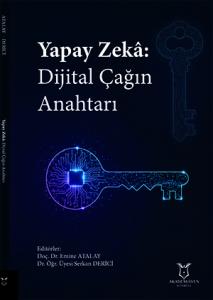
Karar Vermede Yapay Zeka Tabanlı Derin Öğrenme ve Makine Öğrenmesi Algoritmaları: Yapay Zeka ile Bütünleşme
Özet
İnsanoğlu George Boole’un matematik ile mantığı ilişkilendirmesi, Pascal’ın basit dört işlem yapan hesap makinesini icat etmesi ve ilk bilgisayar ENIAC’ın icat edilmesinden sonra düzenli olarak ve giderek artan bir şekilde makineleri kullanmaya başlamıştır. 2010 yılında son sanayi devriminin ilan edilmesi ve yapay zekâ olarak yeni teknoloji ve bileşenlerin isimlendirilmesiyle birlikte tahmin edemeyeceğimiz bir hızda gelişmeler olmuştur. Artık hayatımızın ayrılmaz bir bütünü olan yapay zekâ ürünlerinin ve günümüzde endişe verici bir şekilde artan yapay zekâya dayalı makinelerin öğrenmesini ve düşünmesini ifade eden makine öğrenmesi kullanımının anlaşılması gerekmektedir. Bu nedenle bu bölümde Kurt Gödel’den başlayarak günümüze kadar yapılan makine öğrenmesi uygulamalarından bahsedilerek; makine öğrenmesinin dünü, bugünü ve geleceği açıklanacaktır. Bu sayede makine öğrenmesinin ne olduğu, nelerde kullanıldığı ve gelecekte hangi gelişmeler olacağına dair bilgiler edinmemiz olanaklı olacaktır.
The humankind started to use machines regularly and increasingly after George Boole associated mathematics with logic, Pascal invented the simple four-operation calculator and the first computer ENIAC was invented. In 2010, the last industrial revolution was declared and new technologies and components were named artificial intelligence. It is necessary to understand the products of artificial intelligence, which are now an integral part of our lives, and the use of machine learning, which refers to the learning and thinking of machines based on artificial intelligence, which is increasing at an alarming rate today. Therefore, in this section, the past, present and future of machine learning will be explained by mentioning machine learning applications starting from Kurt Gödel until today. In this way, it will be possible to obtain information about what machine learning is, what it is used for and what developments will take place in the future.
Referanslar
Aghdaie, M. H., Zolfani, S. H., & Zavadskas, E. K. (2013). Decision making in machine tool selection: An integrated approach with SWARA and COPRAS-G methods. Engineering economics, 24(1), 5-17.
Agrawal, V., Seth, N., & Dixit, J. K. (2022). A combined AHP–TOPSIS–DEMATEL approach for evaluating success factors of e-service quality: an experience from Indian banking industry. Electronic Commerce Research, 1-33.
Arf, C (1959). Makineler Düşünebilir mi ve Nasıl Düşünebilir? Halk Konferansları, Atatürk Üniversitesi.
Arsham, H. (2010). Leadership decision making. Retrieved February, 23, 2012.
Aruldoss, M., Lakshmi, T. M., & Venkatesan, V. P. (2013). A survey on multi criteria decision making methods and its applications. American Journal of Information Systems, 1(1), 31-43.
Atalay, E., & Yıldız, F. Z. (2023). İnsan kaynakları yönetimi uygulamalarında dijital dönüşüm. In Ş. Karabulut (Ed.), Akademik Perspektiften Yönetim ve Strateji Konuları (pp. 29–39). Yaz Yayınları.
Attaran, M., & Deb, P. (2018). Machine learning: the new'big thing'for competitive advantage. International Journal of Knowledge Engineering and Data Mining, 5(4), 277-305.
BarNir, A., Gallaugher, J. M., & Auger, P. (2003). Business process digitization, strategy, and the impact of firm age and size: the case of the magazine publishing industry. Journal of Business Venturing, 18(6), 789-814.
Benko, A., & Lányi, C. S. (2009). History of artificial intelligence. In Encyclopedia of Information Science and Technology, Second Edition (pp. 1759-1762). IGI global.
Boole, G. (1847). The mathematical analysis of logic. Philosophical Library.
Boole, G. (2012). Studies in logic and probability. Courier Corporation.
Brandenberger, L., Bakhteev, O., Fernandez, J. M., Schlosser, S., & Salamanca, L. (2024). Introducing embed2discover: A tool for semi-automated, dictionary-based content-analysis.
Brugha, C. M. (2004). Structure of multi-criteria decision-making. Journal of the Operational research Society, 55(11), 1156-1168.
Chalasani, S. H., Syed, J., Ramesh, M., Patil, V., & Kumar, T. P. (2023). Artificial intelligence in the field of pharmacy practice: A literature review. Exploratory research in clinical and social pharmacy, 12, 100346.
Churchland, A. K., Kiani, R., & Shadlen, M. N. (2008). Decision-making with multiple alternatives. Nature neuroscience, 11(6), 693-702.
Elden B. (2024) İşletmelerde Dijitalleşme Sürecinde Dijital Liderliğin Önemi. Yönetim Ve Organizasyon Alanında Uluslararası Araştırma Ve Değerlendirmeler, Serüven Yayınevi.
Feferman, S. (2012). Kurt Gödel: conviction and caution. In Godel's Theorem in Focus (pp. 96-114). Routledge.
Franklin, S. (2014). History, motivations and core themes of AI.
Gupta, R. (2025). Comparative Analysis of DeepSeek R1, ChatGPT, Gemini, Alibaba, and LLaMA: Performance, Reasoning Capabilities, and Political Bias. Authorea Preprints.
Haigh, T., Priestley, P. M., & Rope, C. (2016). ENIAC in action: Making and remaking the modern computer. MIT press.
Hussain, M., Zhu, W., Zhang, W., Abidi, S. M. R., & Ali, S. (2019). Using machine learning to predict student difficulties from learning session data. Artificial Intelligence Review, 52, 381-407.
Kagermann, H., Lukas, W. D., & Wahlster, W. (2011). Industrie 4.0: Mit dem Internet der Dinge auf dem Weg zur 4. industriellen Revolution. VDI nachrichten, 13(1), 2-3.
Kagermann, H. (2014). Change through digitization—Value creation in the age of Industry 4.0. In Management of permanent change (pp. 23-45). Wiesbaden: Springer Fachmedien Wiesbaden.
Lake, B. M., Ullman, T. D., Tenenbaum, J. B., & Gershman, S. J. (2017). Building machines that learn and think like people. Behavioral and brain sciences, 40, e253.
Lee, K., Park, J., Kim, I., & Choi, Y. (2018). Predicting movie success with machine learning techniques: ways to improve accuracy. Information Systems Frontiers, 20, 577-588.
Li, J., Xu, Q., Shah, N., & Mackey, T. K. (2019). A machine learning approach for the detection and characterization of illicit drug dealers on instagram: model evaluation study. Journal of medical Internet research, 21(6), e13803.
Macı, S. M. (2025). The impact of artificial intelligence (AI) on translation: An overview. International Journal of Language Studies, 19(2).
Metz, C. (2022). Genius makers: The mavericks who brought AI to Google, Facebook, and the world. Penguin.
Mueller, J. P., & Massaron, L. (2021). Machine learning for dummies. John Wiley & Sons.
Samuel, A. L. (1959). Some studies in machine learning using the game of checkers. IBM Journal of research and development, 3(3), 210-229.
Sejnowski, T. J. (2018). The deep learning revolution. MIT press.
Sharpe, R., Beetham, H., & De Freitas, S. (2010). Rethinking learning for a digital age: How learners are shaping their own experiences. Routledge.
Stonier, T. (2012). Beyond information: The natural history of intelligence. Springer Science & Business Media.
Strzelecki, A. (2024). Is ChatGPT-like technology going to replace commercial search engines?. Library Hi Tech News, 41(6), 18-21.
Yu, J., & Egger, R. (2021). Color and engagement in touristic Instagram pictures: A machine learning approach. Annals of Tourism Research, 89, 103204.
Yücel, Ş. (2024). İşletmelerde Karar Verme Teknikleri. EĞİTİM YAYINEVİ.
Xu, J. (2024). Strategic Emerging Industry: Analysis of Development of New Energy Vehicles (Doctoral dissertation, Politecnico di Torino).
Zavadskas, E. K., & Turskis, Z. (2011). Multiple criteria decision making (MCDM) methods in economics: an overview. Technological and economic development of economy, 17(2), 397-427.