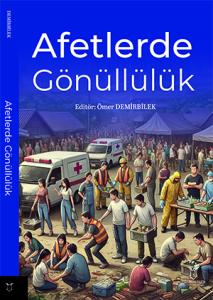
Afetlerde Gönüllü Yönetimi
Özet
Fiziksel, sosyal, ekonomik ve çevresel hasarlara yol açan afetler, geçmişten günümüze sayısı ve şiddeti giderek artan ve mevcut dünya koşulları ile gelecekte de olumsuz etkilere yol açabilme potansiyeline sahip olaylardır. İnsan yaşamı ve faaliyetleri üzerinde olumsuz etkilere sahip afetlere karşı ise, edinilen deneyimler neticesinde hem bilim insanları hem de ilgili uluslararası organizasyonlar afet risk azaltma çalışmalarına vurgu yapmaktadır. Geniş bir faaliyetler yelpazesine sahip afet risk yönetimi uygulamalarının en önemli unsurlarından biri olarak afet risk yönetişimi yaklaşımı görülmektedir. Genel anlamda, kamu kurum ve kuruluşlarının yanı sıra sivil toplum kuruluşları, gönüllüler ve farklı demografik gruplardan vatandaşların, afet yönetimin birer parçası olarak kabul edilmesi ve yönetime dahil edilmesini vurgulayan bu yaklaşımda, yönetişimin sağlanabilmesi için ilgili insan kaynağının etkin kullanılması kritik bir öneme sahiptir. Nitekim, söz konusu insan kaynağı özellikle afet ve acil durumlar sonrasında müdahale ve iyileştirme çalışmalarına önemli katkılar sağlamasının yanı sıra önemli bir ekonomik ve iş gücü kaynağı olarak da nitelendirilmektedir. Bu bağlamda, afet ve acil durumlara ilişkin sivil toplum kuruluşları ve gönüllüler için geliştirilmiş yönetim stratejileri ve izlenen politikalar bu çalışmanın inceleme konusu olup, afet gönüllüleri ve afet gönüllü yönetimi konuları ele alınmaktadır.
Referanslar
AFAD. (2018). Türkiye’de Afet Yönetimi ve Doğa Kaynaklı Afet İstatistikleri. AFAD. https://www.afad.gov.tr/kitaplar
AFAD. (2024). Stratejik Plan 2024-2028. Stratejik Planlar. https://www.afad.gov.tr/stratejik-planlar
AFAD. (t.y.a). Açıklamalı Afet Yönetimi Terimler Sözlüğü. https://www.afad.gov.tr/aciklamali-afet-yonetimi-terimleri-sozlugu
AFAD. (t.y.b). AFAD Akredi̇tasyon. https://akreditasyon.afad.gov.tr/
AFAD. (t.y.c). AFAD Gönüllülük Projesi. AFAD Gönüllülük Projesi. https://www.afad.gov.tr/afad-gonulluluk-projesi
AFAD. (t.y.d). AYDES-Kitle Kaynak. https://www.afad.gov.tr/aydes---kitle-kaynak
Alexander, D. (2010). The voluntary sector in emergency response and civil protection: Review and recommendations. International Journal of Emergency Management, 7(2), 151. https://doi.org/10.1504/IJEM.2010.033654
Başaran, İ., & Akyüz, D. (2022). Afet Yönetiminde Bir Sivil Toplum Kuruluşu: Türk Kızılay. Medeniyet Araştırmaları Dergisi, 7(1), 76-91. https://doi.org/10.52539/mad.1126125
Botzen, W. J. W., Deschenes, O., & Sanders, M. (2019). The Economic Impacts of Natural Disasters: A Review of Models and Empirical Studies. Review of Environmental Economics and Policy, 13(2), 167-188. https://doi.org/10.1093/reep/rez004
Bureau, U. C. (2023). At Height of Pandemic, More Than Half of People Age 16 and Over Helped Neighbors, 23% Formally Volunteered. Census.gov. https://www.census.gov/library/stories/2023/01/volunteering-and-civic-life-in-america.html
Carson, E. D. (1999). Comment: On Defining and Measuring Volunteering in the United States and Abroad. Law and Contemporary Problems, 62(4), 67. https://doi.org/10.2307/1192267
Daddoust, L., Asgary, A., McBey, K. J., Elliott, S., & Normand, A. (2021). Spontaneous volunteer coordination during disasters and emergencies: Opportunities, challenges, and risks. International Journal of Disaster Risk Reduction, 65. https://doi.org/10.1016/j.ijdrr.2021.102546
der Heide, E. A. (2003). Convergence behavior in disasters. Annals of Emergency Medicine, 41(4), 463-466. https://doi.org/10.1067/mem.2003.126
Drabek, T. E., & McEntire, D. A. (2003). Emergent phenomena and the sociology of disaster: Lessons, trends and opportunities from the research literature. Disaster Prevention and Management: An International Journal, 12(2), 97-112. https://doi.org/10.1108/09653560310474214
Dynes, R. R. (1969). Organized Behavior in Disaster: Analysis and Conceptualization. Disaster Research Center, Ohio State University.
Fernandez, L. S., Barbera, J. A., & van Dorp, J. R. (2006). Spontaneous Volunteer Response to Disasters: The Benefits and Consequences of Good Intentions. Journal of Emergency Management, 4(5), 57-68. https://www2.seas.gwu.edu/~dorpjr/Publications/JournalPapers/jemarticle_fernandez.pdf
Fritz, C. E., & Mathewson, J. H. (1957). Convergence Behavior in Disasters. National Academy of Sciences-National Research Council. https://archive.org/details/convergencebehav00fritrich/page/i/mode/1up?view=theater
IFRC. (2022). Everyone Counts Report 2022. https://www.ifrc.org/sites/default/files/2022-04/Everyone%20Counts%20Report%202022%20EN.pdf
Independent Sector. (2024). Value of Volunteer Ti̇me. Independent Sector. https://independentsector.org/resource/value-of-volunteer-time/
Jalali, R. (2002). Civil Society and the State: Turkey After the Earthquake. Disasters, 26(2), 120-139. https://doi.org/10.1111/1467-7717.00196
Kreitner, R. (1998). Management (7th ed). Houghton Mifflin.
Orloff, L. (2011). Managing spontaneous community volunteers in disasters: A field manual. CRC Press.
Paciarotti, C., Cesaroni, A., & Bevilacqua, M. (2018). The management of spontaneous volunteers: A successful model from a flood emergency in Italy. International Journal of Disaster Risk Reduction, 31, 260-274. https://doi.org/10.1016/j.ijdrr.2018.05.013
Provitolo, D., Dubos-Paillard, E., & Müller, J.-P. (2011, Eylül 15). Emergent Human Behaviour During a Disaster: Thematic Versus Complexs Approaches. EPNACS 2011 within ECCS’11, Vienna, Austria. https://agritrop.cirad.fr/561127/1/document_561127.pdf
Roth, F., & Prior, T. (2019). Volunteerism in Disaster Management: Opportunities, Challenges and Instruments for Improvement (s. 32 p.) [Application/pdf]. ETH Zurich. https://doi.org/10.3929/ETHZ-B-000353819
Safrit, R. D. (2012). Volunteer Models and Management. Içinde The Volunteer Management Handbook (Second Edition, ss. 3-27). Jon Wiley & Sons.
Sauer, L. M., Catlett, C., Tosatto, R., & Kirsch, T. D. (2014). The Utility of and Risks Associated With the Use of Spontaneous Volunteers in Disaster Response: A Survey. Disaster Medicine and Public Health Preparedness, 8(1), 65-69. https://doi.org/10.1017/dmp.2014.12
Shaskolsky, L. (1965). Volunteerism in Disaster Situations. http://udspace.udel.edu/handle/19716/1165
TASİP. (2023). Türkiye Afet Sonrası İyileştirme Planı. https://www.agri.edu.tr/upload/Sivil%20savunma%20Koordinatörlüğü/tasip-sivil-savunma.pdf
Tierney, K. (2012). Disaster Governance: Social, Political, and Economic Dimensions. Annual Review of Environment and Resources, 37(1), 341-363. https://doi.org/10.1146/annurev-environ-020911-095618
Türk Mühendis ve Mimar Odaları Birliği. (2023, Ağustos 6). TMMOB Kahramanmaraş Depremleri̇ Raporu Yayinlandi. www.tmmob.org.tr. https://www.tmmob.org.tr/icerik/tmmob-kahramanmaras-depremleri-raporu-yayinlandi
Türkiye Cumhuriyeti Cumhurbaşkanlığı Strateji ve Bütçe Başkanlığı (T.C. Cumhurbaşkanlığı SBB). (2023). 2023 Kahramanmaraş ve Hatay Depremleri Raporu (s. 142). Türkiye Cumhuriyeti Cumhurbaşkanlığı Strateji ve Bütçe Başkanlığı. https://www.sbb.gov.tr/wp-content/uploads/2023/03/2023-Kahramanmaras-ve-Hatay-Depremleri-Raporu.pdf
Twigg, J., & Mosel, I. (2017). Emergent groups and spontaneous volunteers in urban disaster response. Environment and Urbanization, 29(2), 443-458. https://doi.org/10.1177/0956247817721413
UNDRR. (2007). Hyogo Framework for Action 2005-2015: Building the Resilience of Nations and Communities to Disasters. United Nations.
UNDRR. (2015). Sendai Framework for Disaster Risk Reduction 2015-2030. United Nations.
UNDRR. (2022). Our world at risk: Transforming governance for a resilient future. United Nations. www.undrr.org/GAR2022
United Nations Office for Disaster Risk Reduction (UNDRR). (2020). Human Cost of Disasters: An Overview of the Last 20 Years (2000-2019). UN Office for Disaster Risk Reduction.
United Nations Volunteers (UNV). (2012). Volunteerism and Disasters. https://www.preventionweb.net/files/33033_33033bookletswvrvolunteerismanddisa.pdf
UNV. (2021). 2022 State of the World’s Volunteerism Report: Building Equal and Inclusive Societies. https://swvr2022.unv.org/wp-content/uploads/2022/04/UNV_SWVR_2022.pdf
Usta, E., & Yükseler, M. (2021). Afetlerde Sosyal Medya Kullanımı ve Etik İkilemler: İzmir Seferihisar Depremi Örneği. Journal of Disaster and Risk, 4(2), 249-269. https://doi.org/10.35341/afet.981246
Wachtendorf, T., & Kendra, J. M. (2004). Considering Convergence, Coordination, and Social Capital in Disasters. http://udspace.udel.edu/handle/19716/737
Whittaker, J., McLennan, B., & Handmer, J. (2015). A review of informal volunteerism in emergencies and disasters: Definition, opportunities and challenges. International Journal of Disaster Risk Reduction, 13, 358-368. https://doi.org/10.1016/j.ijdrr.2015.07.010
Wilson, J. (2000). Volunteering. Annual Review of Sociology, 26(1), 215-240. https://doi.org/10.1146/annurev.soc.26.1.215
Winn, J., Chatfield, S., & Govern, K. H. (2021). Medical Volunteers During Pandemics, Disasters, and Other Emergencies: Management Best Practices. SSRN Electronic Journal. https://doi.org/10.2139/ssrn.3902193
Wolensky, R. P. (1979). Toward a Broader Conceptualization of Volunteerism in Disaster. Journal of Voluntary Action Research, 8(3-4), 33-42. https://doi.org/10.1177/089976407900800306
Yallen, C. N. (2010). Ethical decision-making. Içinde Volunteer Administration: Professional Practice (4th Edition, ss. 51-66). LexisNexis Canada.
Yükseler, M. (2023). Afet Gönüllüsü. Içinde Afet Ansiklopedisi (1. Basım, s. 29). Nobel Akademik Yayıncılık.
Yükseler, M., & Yazgan, J. (2023). Spontaneous Volunteers in Emergencies and Disasters. Içinde M. Mokhtari (Ed.), Natural Hazards—New Insights. IntechOpen. https://doi.org/10.5772/intechopen.109330
Yükseler, M., Yazgan, J., & Teni̇kler, G. (2024). Anlık Gönüllülük Olgusunun Türkiye’deki Afet ve Acil Durum Yönetimi Açısından Değerlendirilmesi. İktisadi ve İdari Bilimler Fakültesi Dergisi. https://doi.org/10.33707/akuiibfd.1311962