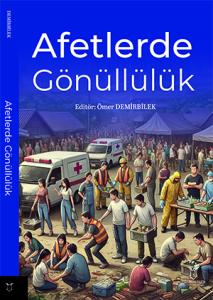
Afetlerde Gönüllülüğün Gerekliliği ve Önemi
Özet
Afetlerde gönüllülük, kriz anlarında hızlı ve etkili müdahale için hayati bir rol oynamaktadır. Afetler, ani, beklenmedik ve kaotik durumlar olduğu için, resmî yardım ekipleri çoğu zaman yeterli olmamakta ya da zamanında afet bölgesine ulaşamamaktadırlar. Bu aşamada gönüllüler, afet bölgelerine hızla ulaşıp, temel ihtiyaçları karşılayarak önemli bir boşluğu doldurmakta ve genellikle ilk müdahale ekibi olarak anılmaktadırlar. Bu sebeple afetlerin ilk anından itibaren olay yerine gelen gönüllülerin bireysel etkinlik ve verimliliğinin artırılması ile can ve mal kaybının önemli oranda azalacağı açıktır. Gönüllülerin afet zamanlarında hızlı reaksiyon alabilme, anlık müdahale ve acil yardım hizmetlerini tamamlayan çok yönlü katkıları açıkça görülmektedir. Ayrıca, yerel halkın bir parçası olan gönüllüler, bölgenin kültürel ve sosyal dinamiklerini iyi bildikleri için, hassas gruplara yönelik yardımları daha empatik ve etkili şekilde gerçekleştirebilirler. Daha önemlisi gönüllüler, acil yardım çabalarının ötesine geçerek toplumun dirençliliğini/dayanıklılığını artırmaya, ekonomik toparlanmayı hızlandırmaya, hayatta kalanlar arasında psikososyal destek ile refahı artırmaya ve toplumu güçlendirmeye teşvik etmektedir. Afetlerde gönüllülüğün önemi, sadece acil müdahale ve kurtarma çalışmalarıyla sınırlı kalmaz; zarar azaltma ve hazırlık evrelerinde de farkındalık yaratmak, toplulukların eğitilmesi ve olası afetlere karşı hazırlık yapmak gibi konularda kritik roller üstlenmektedirler. Bu çalışmanın amacı etkin ve nitelikli gönüllülüğün afet zamanlarındaki bireysel ve toplumsal faydalarını açıklayarak gönüllü insan kaynağının afet yönetimi sürecinin vazgeçilmez bir unsuru olduğunu alan yazın ve saha tecrübeleriyle ortaya koymaktır.
Referanslar
AFAD. (2022). Türkiye Afet Müdahale Planı (TAMP). https://www.afad.gov.tr/kurumlar/afad.gov.tr/e_Kutuphane/Planlar/TAMP.pdf adresinden erişildi
AFAD. (2024a). 2024-2028 Stratejik Planı. https://www.afad.gov.tr/kurumlar/afad.gov.tr/e_Kutuphane/Planlar/2024_2028-AFAD-Stratejik-Plani.pdf adresinden erişildi
AFAD. (2024b). 2024 yılı Performans Programı. https://www.sbb.gov.tr/wp-content/uploads/2024/01/2024-Yili-Performans-Programi.pdf adresinden erişildi
Afet ve Acil Durum Yönetimi Başkanlığı (AFAD). (2018). Türkiye’de Afet Yönetimi ve Doğa Kaynakli Afet İstatistikleri. https://www.afad.gov.tr/kurumlar/afad.gov.tr/35429/xfiles/turkiye_de_afetler.pdf#page=44.14 adresinden erişildi
Akgüngör, A. Ç. (2010). Toplumbilim perspektifinden afeti düşünmek. LAÜ Sosyal Bilimler Dergisi, 1(1), 3-22.
Anadolu Ajansı, A. A. (2024). Türkiye'de afet gönüllülerinin sayısı 1,5 milyona ulaştı(Vol. 2024). https://www.aa.com.tr/tr/gundem/turkiyede-afet-gonullulerinin-sayisi-1-5-milyona-ulasti/3197479 adresinden erişildi
Arbon, P., Bobrowski, C., Zeitz, K., Hooper, C., Williams, J.,Thitchener, J. (2006). Australian nurses volunteering for the Sumatra-Andaman earthquake and tsunami of 2004: A review of experience and analysis of data collected by the Tsunami Volunteer Hotline. Australasian Emergency Nursing Journal, 9(4), 171-178.
Australia, V. (2023). National strategy for volunteering 2023-2033.
Baran, A. G. (2019). Türkiye’de Gençlerin Gönüllülük Faaliyetlerine Katılım Durumu. Gençlik Araştırmaları Dergisi, 7(Gençlik ve Gönüllülük), 5-26.
Barraket, J., Keast, R. L., Newton, C., Walters, K., ve James, E. (2013). Spontaneous volunteering during natural disasters.
Boztilki, M., ve Barış, İ. (2024). A Research on The Experiences of Disaster Volunteers on 2023 Kahramanmaras Earthquakes. Amme İdare Dergisi.
Çakacak, Ö. (2008). Toplum afet müdahale ekipleri. Afet Zararlarını Azaltmanın Temel İlkeleri, Ankara, Jıca Türkiye Ofisi.
Çevik, A., ve Gürsel, F. (2015). Gönüllü Motivasyon Envanteri: Türk Popülâsyonuna Uyarlanması. SPORMETRE Beden Eğitimi ve Spor Bilimleri Dergisi, 13(2), 83-92.
Daddoust, L., Asgary, A., McBey, K. J., Elliott, S., ve Normand, A. (2021). Spontaneous volunteer coordination during disasters and emergencies: Opportunities, challenges, and risks. International Journal of Disaster Risk Reduction, 65, 102546.
Demirbilek, Ö., ve Öztürk, S. (2023). Understanding university students WHO do not want to volunteer in disasters: A qualitative study from Türkiye. International Journal of Disaster Risk Reduction, 96, 103994. doi:https://doi.org/10.1016/j.ijdrr.2023.103994
Demiroz, F., ve Hu, Q. (2014). The role of nonprofits and civil society in post-disaster recovery and development. Disaster and development: Examining global issues and cases, 317-330.
Drabek, T. L., ve McEntire, D. A. (2002). Emergent phenomena and multiorganizational coordination in disasters: Lessons from the research literature. International Journal of Mass Emergencies & Disasters, 20(2), 197-224.
Dynes, R. (2003). Noah And Disaster Planning: The Cultural Significance Of The Flood Story. Journal of Contingencies and Crisis Management, 11. doi:10.1111/j.0966-0879.2003.01104003.x
Dynes, R. R. (1970). Organized behavior in disaster: Heath Lexington Books.
Eller, W. S., Gerber, B. J., ve Robinson, S. E. (2018). Nonprofit organizations and community disaster recovery: Assessing the value and impact of intersector collaboration. Natural hazards review, 19(1), 05017007.
Emergency Disaster Database (EM-DAT). (2024). Classification(Vol. 2024). https://public.emdat.be/data adresinden erişildi
Erkan, A. (2010). Afet Yönetiminde Risk Azaltma ve Türkiye’de Yaşanan Sorunlar, Uzmanlık Tezi. Devlet Planlama Teşkilatı.
FEMA. (1999). The role of voluntary agencies in emergency management. Washington DC: FEMA.
Fischer, L. R., ve Schaffer, K. B. (1993). Older volunteers: A guide to research and practice. (No Title).
Fritz, C. E., ve Mathewson, J. H. (1957). Convergence behavior in disasters: A problem in social control: National Academy of Sciences-National Research Councel.
Ganoe, M., Roslida, J., ve Sihotang, T. (2023). The Impact of Volunteerism on Community Resilience in Disaster Management. Jurnal Ilmu Pendidikan dan Humaniora, 12, 199-213. doi:10.35335/jiph.v12i3.11
Göcenoğlu, H. C. (2022). Volunteerism and Working with Volunteers. https://iupress.istanbul.edu.tr/en/book/volunteerism-and-working-with-volunteers/home adresinden erişildi
Heidarpoor, P., Maniati, M., Cheraghi, M., Beheshtinasab, M., ve Afshari, P. (2021). Organization of volunteers in the healthcare system and the type of services provided by them during the COVID-19 pandemic. Family Medicine & Primary Care Review, 23(2).
Kadıoğlu, M. (2022). Afet yönetimi: Beklenilmeyeni beklemek, en kötüsünü yönetmek: Marmara Belediyeler Birliği.
Kapucu, N. (2006). Interagency communication networks during emergencies: Boundary spanners in multiagency coordination. The American review of public administration, 36(2), 207-225.
Kayasü, S. (2007). Afet Yönetiminin Kurumsallaşmasında Sivil Toplum Kuruluşlarının Rolü. Afet Risk Yönetimi Risk Azaltma ve Yerel Yönetimler.(Ed. Erkan, NE, 65-74.
Lin, N., Ye, X., ve Ensel, W. M. (1999). Social support and depressed mood: A structural analysis. Journal of health and social behavior, 344-359.
Lindner, S., Kuehnel, S., Betke, H., ve Sackmann, S. (2018). Simulating Spontaneous Volunteers-A Conceptual Model. Paper presented at the ISCRAM.
Ma, Y., Zhu, W., Zhang, H., Zhao, P., Wang, Y.,Zhang, Q. (2021). The factors affecting volunteers’ willingness to participate in disaster preparedness. International journal of environmental research and public health, 18(8), 4141.
McCullough, D. (2007). Johnstown Flood: Simon and Schuster.
Midlarsky, E. (1991). Helping as coping.
Mondal, D., Chowdhury, S., ve Basu, D. (2015). Role of non governmental organization in disaster management. Research Journal of Agricultural Sciences, 6(2), 1485-1489.
Musick, M. A., ve Wilson, J. (2003). Volunteering and depression: the role of psychological and social resources in different age groups. Social Science & Medicine, 56(2), 259-269. doi:https://doi.org/10.1016/S0277-9536(02)00025-4
Neumayer, E., Plümper, T., ve Barthel, F. (2014). The political economy of natural disaster damage. Global Environmental Change, 24, 8-19. doi:http://dx.doi.org/10.1016/j.gloenvcha.2013.03.011
Omoto, A. M., Snyder, M., ve Berghuis, J. P. (1993). The psychology of volunteerism: A conceptual analysis and a program of action research.
Orloff, L. (2011). Managing spontaneous community volunteers in disasters: a field manual: Crc Press.
Özmete, E. (2023). Afet Sonrası Birey, Grup ve Toplum Temelli Psikososyal Destek: Akademisyen Kitabevi.
Phillips, B. D. (2020). Disaster Volunteers: Recruiting and Managing People Who Want to Help: Butterworth-Heinemann.
Rietschlin, J. (1998). Voluntary association membership and psychological distress. Journal of health and social behavior, 348-355.
Ross, G. A. (1980). The emergence of organization sets in three ecumenical disaster recovery organizations: An empirical and theoretical exploration. Human Relations, 33(1), 23-39.
Saçlı, A. (2023). 100 Years Housing Policies of The Republic of Türkiye. International Journal of Middle East Research.
Simo, G., ve Bies, A. L. (2007). The role of nonprofits in disaster response: An expanded model of cross‐sector collaboration. Public administration review, 67, 125-142.
Stallings, R. A., ve Quarantelli, E. L. (1985). Emergent citizen groups and emergency management. Public administration review, 45, 93-100.
Şentürk, M., Adıgüzel, Y., Turan, B., Tanıtım, G., Baş, M. F.,Sitesi, M. (2016). ÜNİVERSİTEDE GÖNÜLLÜ OLMAK.
Şentürk, M., ve Turan Tüylüoğlu, B. (2022). Defining Volunteerism. Volunteerism and Working with Volunteers, 41-60.
T.C. Cumhurbaşkanlığı Strateji ve Bütçe Başkanlığı (SBB). (2023). Kahramanmaraş ve Hatay depremleri raporuStrateji ve Bütçe Başkanlığı. https://www.sbb.gov.tr/wp-content/uploads/2023/03/2023-Kahramanmaras-ve-Hatay-Depremleri-Raporu.pdf adresinden erişildi
Tang, G., ve Wang, F. (2020). What factors contribute to nonprofit collaboration? An analysis of response and recovery efforts after the 2008 Wenchuan Earthquake, China. Safety Science, 125, 104624. doi:https://doi.org/10.1016/j.ssci.2020.104624
Twigg, J., ve Mosel, I. (2017). Emergent groups and spontaneous volunteers in urban disaster response. Environment and Urbanization, 29(2), 443-458. doi:10.1177/0956247817721413
UN Volunteers. (2007). Contribution of Volunteerism
to Disaster Risk Reduction. Retrieved from https://www.unv.org/Success-stories/five-facts-volunteerism-and-sendai-framework
UN Volunteers. (2017). Five facts on volunteerism and the Sendai Framework. Retrieved from https://www.unv.org/Success-stories/five-facts-volunteerism-and-sendai-framework
Wachtendorf, T., ve Kendra, J. M. (2004). Considering convergence, coordination, and social capital in disasters.
Whittaker, J., McLennan, B., ve Handmer, J. (2015). A review of informal volunteerism in emergencies and disasters: Definition, opportunities and challenges. International Journal of Disaster Risk Reduction, 13, 358-368.
Wuthnow, R. (1998). Loose connections: joining together in Amarica's fragmented communities. (No Title).
Yaman, Y. (2005). Sivil toplum kuruluşlarında birbirinden öğrenme: Benchmarking. Sivil Toplum Kuruluşları İçin Yönetim Rehberi, Kaknüs Yayınları, İstanbul.
Yang, K. (2015). The Key Factors of Successful Self-organizing Cooperation between Different Social Organizations--Based on the NGOs' Alliance during the Wenchuan Earthquake Relief in Shannxi Province. Chinese Public Administration, 362(8), 66-70.
Yükseler, M., Yazgan, J., ve Tenikler, G. (2024). Anlık gönüllülük olgusunun Türkiye’deki afet ve acil durum yönetimi açısından değerlendirilmesi. Afyon Kocatepe Üniversitesi İktisadi ve İdari Bilimler Fakültesi Dergisi, 26(1), 1-17.
Zhu, J., Wang, C., ve Hu, M. (2009). Obligation, Action and Cooperation: Case Studies of NGOs’ Participation in the Sichuan Earthquake Relief. In: Beijing: Beijing University Press.